English Literature 1 Spring 2014 -- Mr. Furr
Homework Page
Back to Home Page for this course. To schedule of readings.
I will post all writing assignments on this page.. You should create a 'bookmark' of
your own to this page, so you can go to it without having to first go to the Home Page for
the course.
NOTE: BE SURE TO USE THE PROPER SUBJECT LINE ON ALL HW
ASSIGNMENTS! SEE BOTTOM OF HOME PAGE FOR EXAMPLE!
Be sure to "send a
copy to yourself" of ALL your homework assignments!
IMPORTANT
We cannot have good in-class discussions unless each student has 1. the TEXT we
are discussing that day; and 2. a copy of his/her HW assignment, to refresh your memory
about what you have written.
Therefore, be sure to bring with you to class, every day:
- The TEXT WE ARE DISCUSSING THAT DAY and on which you have written your
HW assignment;
- A PRINTED COPY OF YOUR HW ASSIGNMENT for that day.
If you have either or both of these on a laptop or tablet and bring that to
class, you do not need to print them.
Be sure these items are clearly visible on your desk as I take attendance each
day. I will take note. |
HOMEWORK ASSIGNMENTS
- For Thursday January 23: You have a lot, to get us started.
- send me two emails, from different email accounts, on two different
servers
- One of these MUST be the MSU 'mail' account. It is "free" (you've already paid
for it, in your tuition), but you MUST use it for this course.
- See the full instructions on the Internet page.
- See the list of free web-based email providers at the bottom of our Home
Page.
- Make sure that the Subject line of the email messages conforms to the model at the
bottom of our Home Page.
- Read our text, pp. 1-12, "The Medieval Period", up to the end of 7
"England Before the Norman Conquest." Do this
assigment.
Assignments on Old English Poetry and Beowulf
- For Tuesday, January 28. Do this assignment on
"The Wanderer" and "The Seafarer," pp. 52-55. Take your time -- this
involves some reading!
- For Thursday, January 30 . Note: by today, make
sure you have read 1/2 of Beowulf, pp. 65 - 85, to the end of § 23.
- Please print out and read either 'The
Battle of Finnsburh" or "The
Battle of Brunanburh". (The OE text is on the left or above the modern text).
These passages give you a good idea of what other OE and early Germanic heroic poems were
like.
- Now, read a few stanzas of Y
Gododdin. This is the earliest British poem and is in the Celtic language of
Brythonic (now called "Old Welsh"). It was not written in Wales but in what is
now Yorkshire, England, or Southern Scotland, probably shortlhy after 598 A.D. This gives
you a good idea of what heroic Celtic poetry was like.
- For Tuesday, February 4. By this assignment you
should have finished reading Beowulf. We'll finish discussing it in the
first half of Thursday's class.
Assignments on Middle English Literature
Middle English Lyrics
Please read this page: "Now that we have
completed the first two weeks of the class..."
Assignments on Sir Gawain and the Green Knight
Read Constantine Cavafy's wonderful poem "Ithaca" (1911).
There are many translations. I like this one. But there's also this one, and this
one,
See these images of the "Wheel of
Forture".
Thursday, February
13 - Montclair State University closed because of snow storm. All classes cancelled.
The assignment for Thursday, February 13 is now due
Tuesday, February 18.
If you have already sent it with the date of the 18th, that's fine. You do not
have to email it again.
If you haven't sent it yet, please use the new class / due / date of February 18. |
- For Tuesday, February 18. This assignment involves
listening to a 45-minute long lecture by a famous medievalist. It is a REALLY GOOD
lecture, and you will learn a lot by listening to it.
If you don't have the free RealPlayer (most computers come with it already installed) you
can download it FREE from here or see the
"Streaming Audio Instructions" box in the table on our course's Home Page.
- For Thursday, February 20. Make sure you have read all of SGGK
carefully. We'll discuss Boethian echoes and Christian allegory. No written assignment,
but please bring the materials you already have.
- Boethian echoes: I have already given you this in class, but take another look here. Please print out and bring
to class (unless you have it already or have a laptop, tablet, etc.)
- Christian allegory: A big topic! Let's start with some motifs that are common in
chivalric romances, like this one on horses and
hunts. Please print out and bring to class (unless you have it already or have
a laptop, tablet, etc.)
Geoffrey Chaucer
- For Tuesday, February 25: on the General Prolog to The
Canterbury Tales. NOTE: No written assignment for today because the one for Thursday
is somewhat longer than usual. So, just read the General Prolog carefully and
bring your text to class with you.
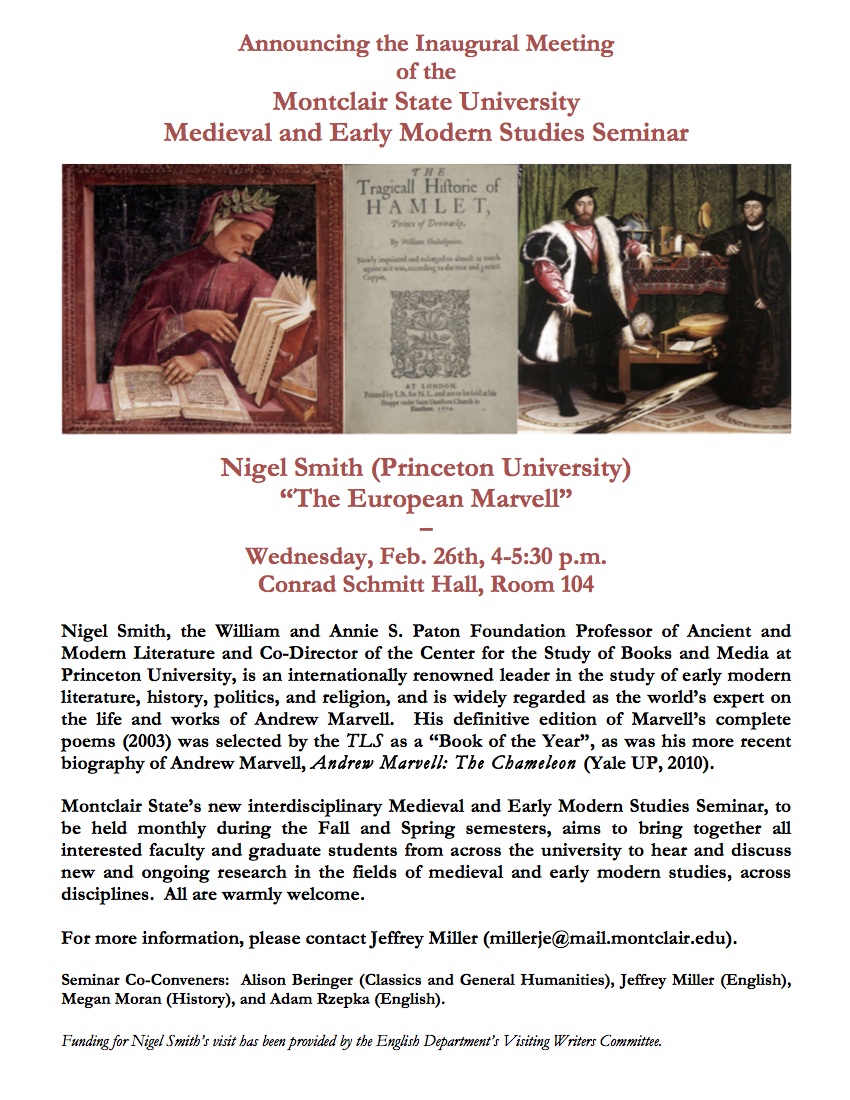
Montclair State University Medieval and Early Modern
Studies Seminar!
Wednesday, February 26, 4:00 - 5:30 p.m.,
CS 014 (Conrad Schmitt Hall)
Professor Nigel Smith (Princeton University) will talk on
"The European Marvell"
(that's Andrew Marvell, one of the greatest English poets of the
17th century)
See full details on the
beautiful graphic poster here!
Please attend! It's not "required"
-- but you really should go to this talk, for your own edification. |
Everyman
- For Tuesday, March 18. No additional readings today; just
the text of the morality play itself.
Also: Mid-Term Examination in class! Just 20 minutes. Be sure to attend class
-- no makeups!
Assignments on Renaissance Literature -- the Sixteenth Century
Wyatt, Surrey, English and Petrarchan Sonnets
Spenser, Epithalamion
Spenser, The Faerie Queene
[NOTE: Go here for a brief summary of the whole Faerie
Queene. It's very helpful! ]
- For Thursday, March 27: Make sure you have read the material listed for
today on our schedule page: "Introductory pages on Edmund
Spenser and his epic The Faerie Queene, pp. 555-558 (old edition: pp. 573-576) and
the "Bower of Bliss", and the "Garden of Adonis"
- For Thursday, March 27 on the "Bower of
Bliss", the "Garden of Adonis", and the
"Mutabilitie Cantos" of Spenser's magnificent epic The Faerie Queene.
- For Tuesday, April 1 This is our "catch-up" day! Bring
"The Mutabilitie Cantos" and read the introductory material on Spense and on The
Faerie Queene (2nd edition pp. 555-8; 1st ed. pp. 573-6). We shall finish up Spenser.
Marlowe, The Tragical History of Doctor Faustus
- For Thursday, April 3:
- Read Acts I and II only. No writing assignment for today.
Please read these brief pages for background on the Faust legend and on Marlowe's
famous play. "You'll be glad you did!"
- Read the introductory material on Marlowe, pp. 743-744 (old edition pp. 736-737), and on
Dr. Faustus, pp. 757-758 (old edition pp. 750-751.)
NOTE: Some people believe that not
Shakespeare but Christopher Marlowe actually wrote Shakespeare's plays! This is a
really interesting question, which you can, if you wish, begin to explore on this page.
Fascinating stuff! This is not "required" for the course -- but who would be
so dull of mind as to miss it? Surely not you?? (I didn't think so!)
- For Tuesday, April 8: Finish reading Marlowe, Doctor Faustus. No
writing assignment for today.
- Time permitting, e will also begin our review of British History. Please carefully read the Wikipedia page on The Tudor Dynasty.
Print it out and bring it to class with you. This will give you some idea of the
very tense political situation that existed during the time Wyatt, Surrey, Spenser,
Marlowe, and Shakespeare were writing.
- Pay special attention to "The
Age of Intrigues and Plots: Elizabeth I."
- To really get an idea of the kind of social and political unrest that characterized this
whole period, from the 1530s to the end of Elizabeth I's reign (and really long after that
too), read a few of these pages on some of the significant rebellions and wars:
NOTE on Explicitly Bawdy Language
Explicit sexual and bawdy, or ribald, language and its use in literature was common
until about the second half of the 18th century. Since the Romantic and especially the
Victorian periods ribald language has been considered "obscene." Earlier works
of literature were either censored altogether or "expurgated" (= censored), with
ribald passages removed. The most famous example of this is the "Bowdlerization" of
Shakespeare's works by Thomas
Bowdler, beginning in 1818.
Not everybody supported the "purification" of literature through censorship
of the bawdy. In 1871 Mark Twain wrote "1601", the full title of which is "
Date, 1601. Conversation, As It Was by the Social Fireside in the Time of the
Tudors." You can read the
Wikipedia article about "1601"; the publication history followed by the text;
and a
facsimile of an early edition.
It's important to understand that modern and contemporary squeamishness about the
discussion of sex, sexuality, bodily functions, and the like is a mark of Romantic and
post-Romantic style and sensibility, and not an "eternal" marker of "good
taste" or quality in literature, art, and culture generally. |
Shakespeare, The Sonnets
- For Thursday, April 10. Do the HW on the
Sonnets. We'll discuss them and then take up King Lear, which we also have
for the following class.
Shakespeare, King Lear
John Donne, Robert Herrick, Andrew Marvell
- For Tuesday, April 22: No writing assignment. Read through all this
great poetry (see Schedule for what to read). I'll read over a
bit more. Be prepared to read some of it aloud in class.
John Milton
- For Thursday, April 24. This is the assignment on the
shorter poems.
- Take a look at this annotated
online edition of "Lycidas", at the Dartmouth College "Milton Reading
Room." It shows how heavily allusive -- full of allusions to Classical authors
and to the Bible -- Milton's poem is. This is a dimension of the poem that his audience
would have fully appreciated, since they would have been well read in the Classics and the
Bible. Today almost all of us have to learn about it from scholars, as here. We miss this
dimension of Milton's incredible accomplishment, in which almost every line is an allusion
to some other work.
- For Tuesday, April 29 This is the assignment on
"Paradise Lost", Book I.
Thursday, May 1: This is our last day of class (see the MSU Academic Calendar). We'll
discuss end-of-semester matters. Please attend! There'll be some
important things to talk about, and to do.
http://chss.montclair.edu/english/furr/el1/el1hw14.html | Email Me! | Created 20 January 2014